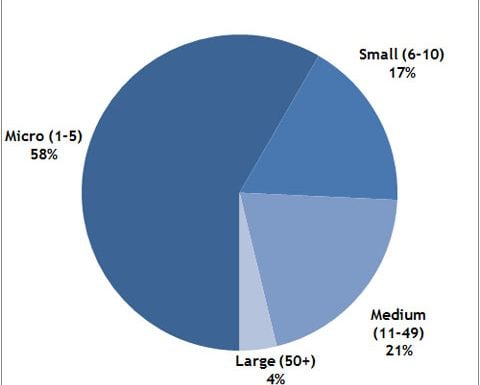
Here is a breakdown of the size of RIBA Chartered architects practices by size (no. of employees). It shows that over three quarters of the 2800 chartered architects practices in the UK have fewer than 10 staff, and more than half have fewer than five.

Why is this important?
Firstly it is interesting to consider why it might be that architects practices are generally so small. As you know I am of the opinion that many architects are not confident about being businessmen and women. Running a business has not been a subject of much consideration traditionally, and from discussions on this blog I’m of the impression that having an interest in business matters, in particular profit, is considered rather distasteful to some.
Nevertheless there is some logic in larger practices being more profitable, especially if they are organised in a way that tasks not required to be performed by a registered architect are done by others, be they part qualified staff, juniors or administrators.
In a small practice however, its much more likely that the partners/architects do everything, including composing and preparing their own documents, processing post, answering the telephone, writing cheques and sticking on stamps. And even more difficult is the delegation of ‘real work’ as it was recently described to me on twitter – the design of buildings. If delegation is difficult for you, then you’re going to be unable to closely supervise more than a couple of people, and even if you’re confident in that, no-one can manage more than 7 people without an additional layer of supervision, at which point the partners have to consider stepping away from the day to day management of projects altogether and get on with building a business, a full time task in itself.
So maybe architects practices are small because their owners don’t want an organisational structure like that. Maybe they are small because their owners want them to be. Or maybe there is another reason.
What do you think?
Before I got involved in the architectural world I’m not sure what I really gave it much thought. When I was given these figures, for which I am grateful to RIBA Director of Practice Adrian Dobson, I was interested to know whether the small size of architects practices would come as a surprise to people. Is it a surprise to you?
Notes: These figures are from July 2008, the height of the boom, and only represent RIBA chartered practices. The RIBA estimated that the 2797 Chartered practices make up about half of all Architects practices in the UK.
Around of third of RIBA chartered architects work in practices under 10 people, a third work in those with 11-50 people and a third in large practices (50+ staff).
Very insightful, Su! It will be interesting to see if/how the recession will impact the average size of architectural practices.
Yes it will be interesting. I’m hoping to get the figures from 2009 soon.
The nature of larger firms is that they have to be more systematic, its a different person who thrives in that versus the smaller firm. Also, the accessibility of principals in smaller firms is compelling to clients.
Hi Lynda,
Agree with you that some staff like smaller firms, some larger.
As far as accessibility of principals is concerned, this doesn’t necessarily have to be correlated with practice size. Larger practices, with better systems of administration and delegation, can still have large numbers of ‘principals’ or senior staff in touch with clients.
Don’t you think? Need to go and find an example…
Su,
Thanks for the insightful post. I realize the numbers are specific to the UK but I am sure the US figures would be similar. Not surprised at all by the figure. I think you have it partially right about Architects not wanting to be burdened with business matters which are generally managerial responsibilities. Pardon me while I generalize/profile/stereotype myself into this category. Hopefully it will make for more colorful and interesting blog comments 😉
Architects walk a fine line between the creative aspect of a business and the business end of being creative. Architects by nature are thinkers, they let their environment inform how they feel, and are trained to relate to their context on a daily basis. Many are jacks-of-all-trades, masters of none. In a world of specialization, they refuse to be pigeonholed into doing one repetitive thing. The problem though, is that many times to be profitable you need to find how to reduce time, and increase efficiency in your process. This is true throughout the business world. Can you be efficiently creative? how does that work? But I digress.
I would liken it to the law profession. I don’t know the figures but there are TONS of lawyers out there operating on their own. Probably for much of the same reasons. Architects like the “doing” part of their business. They enjoy client interaction, being creative, working out the details, and coming to fruition with an end product that makes the client happy. The more you have to manage others the more it takes you away from these things that you hold dear. You are left to “run the business” and find yourself pushing paper more than drawing on it. Even more so now that there is this push for entrepreneur-ism, being your own boss, and working from home so you can have more family time.
The second part of the equation is profitability. these onesey twosey firms at the end of the day are probably more concerned about staying afloat- especially in this economy, than making a profit. Many are lucky to have had ONE project within the last 10 months or more. I don’t necessarily think that architects are allergic to making money, but they have battered wife syndrome, thinking that OOOOH, I got a client and they want to give me money! how much? I dont care, they are giving me money. They have this tarnished self image that they are not allowed to make tons of money for something they love to do. In the end- I don’t think it will change. Part of it is on the part of the client- always looking, in general, for someone to do it cheaper and faster. Most of the projects out there are not high design, they are merely projects to get permits, and tell the contractor where to put walls and what color things are supposed to be. Never mind the fact that they contain important knowledge about life safety, accepted building practices,. accessibility, and a plethora of other information including a lifetime of experience that is not reflected in the final product. At the end of the day, the client gets a permit, and then they get their completed project. the drawings are merely a vessel to take them to their final goal. Large firms can afford to make more money because the level of expertise required to do more complex buildings is more readily apparent in the drawings. They make more money because there is more risk.
RISK- thats a huge part of it. You risk your license every time you sign the drawings. How much risk is that strip mall build out in relation to the new 70,000 seat auditorium. That’s how you get paid. Look at the number of Auditorium sized projects built in a year versus the number of tenant fit out and infill projects there are. I would say its a similar relationship with firm size.
I’m so grateful you took the time to reply Jason. What a rich response!
One of the things I take out of your devils advocate approach is a series of wants which architects often express but perhaps some find it difficult to act on them:
All these things can in theory be achieved, (maybe not all by all architects at once!) the problem is having the will, the motivation to change other things in order for them to happen. And that’s difficult. It involves stepping out of the bustle of the job and looking over the horizon, seeing the big picture, like Philippa Bowen described in her guest blog post.
as a separate comment- does anyone have national building permit figures that could be broken out by construction costs? I highly doubt it but humor me to think that it would be 80% of the construction is less than 2 million dollars US. which would be easily handled by a smaller firm. Not to mention that 2mil construction cost your typical architecture firm is lucky to get 6% of it after being beat up on fees and doling $$ out to various consultants.
Great post, Su. Something that is very near and dear to my heart. As a business analyst that is looking to leave that field and enter architecture, I have spent a considerable amount on time on side of the equation while learning the other.
I agree with Jason’s comments in that smaller firms trying to stay afloat will inevitably “play it safe” and design enough to make ends meet. The problem is that the Managing Partner in architecture firms (and law firms, for that matter) typically hung his/her shingle and grew into a business. To run a business, you have to be comfortable in delegation. This is difficult in something as signature as a building design can be. It makes a large organization inefficient to operate that way. If the founder of the company wants to be hands on, it becomes extremely costly to do so if there are more than a handful of direct reports.
If an environment of latent values of the design process is established early, the named partners can feel more comfortable with delegating the all aspects of a particular design. I have friends that are architects and friends that are lawyers. Both business structures are usually horizontal, rather than top-down, and face the same struggles to run a profitable business because of too much oversight within the firms.
Suffering ‘Too much oversight’ – a great description John.
There are ‘signature’ architecture firms which are large – Foster & Partners for example. And othe companies, like Kelley Hoppen who last week on The Bottom Line (Evan Davis’ business chat show on Radio 4) claimed do design ‘everything’ in her huge interiors company. So it can be done, but it takes a different type of oversight perhaps?
This statistic is completely in line with solicitors’ practices in England & Wales as well as in Scotland which is a separate legal jurisdiction. The figure is that about 45 % of all practice units in these jurisdictions are sole practitioners. Whether or not this is a good business model is questionable, since it often means long hours and working on administration when the core business needs more attention.
Thanks for that Phyllis, I suspect you may be right.
I have met and discussed structure with solicitors who work in larger practices, and they have a strong system of administration (along with time measuring) both of which architects are notoriously bad at!
Perhaps we need to do some cost/benefit analyses of employing admin staff to make the step less painful.
Great Post Su, and something I fully understand.
As an experienced accountant who start out in Banks, moved to a start-up (for the fun of it!) then found his vocation in business coaching, I believe many small business owners suffer from working IN the business not ON the business.
Peter Jones has cited this is numerous forums, and it is a real curse to a business owner, but I believe it is a matter of “perspective” more than a terminal structural flaw… something you design lot must understand.
Article I wrote in 2008 with this in mind – http://mycoachchris.blogspot.com/2008/11/next-step.html
The owner might just be the limiting factor, but if the same person is self aware and looking to do something about it, they can find a path through to a different way of thinking, tear up the business plan (after all, the first year will be significantly different to the 3rd,5th,10th!) and scale in to greater profit… our shared passion, I see!
Great blog!
Coach Chris
Thanks for that Chris, like your post. Courage is something we could all do with a bit more of!
I find if I don’t think too much about the consequences, it can be very scary at the time, but once you’ve taken the plunge and things start happening it all becomes clear.
Thank for sharing good and useful information. This information is very valuable.
Regards.
IT Architects
Thanks Su.
For me, there is an important part here for the RIBA to help with. There is no doubt that today’s economy is having an impact on our members, and particularly those who are running small practices.
With increasing legislation, bureaucracy and administration, it makes these principals or directors work harder and harder – just to stay afloat.
We (the RIBA) need to offer support to these members in these difficult times.
Indeed, the RIBA offers such support, through peer to peer networking and mentoring (branch and regional forums), Small Business Toolkit, Recession Survival Kits, Guerilla Tactics Small Business Conference, and through links with Business Link.
Hi Dhiran,
Would you be willing to collaborate in putting together some links to useful RIBA resources like these? I’m happy to publish them, perhaps in a side bar widget.
Su
Absolutely Su.
In the meantime, RIBA Members can check out https://members.architecture.com/login/login.asp – log in, and then access the Toolkits.
Members are also welcome to drop our Regional Office a line on 0121 233 2321, and speak to our Regional Director with specific enquiries. Help is out there! If it’s not, let me know and we’ll work on it!
Dhiran
I agree all these resources are useful, but I work directly with small architects, and many of them struggle to manage their businesses effectively and have huge concerns over the current climate. Many cite a learning gap (possible in Part 3) of their studies, which could be more business focused.
I am not suprised at the number of small practices, as I believe if you think big, and stay small, it is an absolute strength in recession.
Thanks Chris. Interesting point about Part III Curriculum. What experiences have you had todate? Can we present some better ideas and options through to the RIBA?
At West Midlands, we successfully hosted a mini Guerilla Tactics Seminar last year, and I thought it filled some of those business-savvy learning gaps quite well. Maybe it needs to become a stronger part of the CPD Programme?
Very interesting blog. I had no idea that such the most firms are so small. You mentioned that architects in small practices are often doing everything including time intensive administrative tasks like answering the phone and preparing and sending letters. It always makes me sad to hear of highly qualified and professional people wasting their time and talent completing administrative tasks. Outsource admin to a Virtual Assistant. With a Virtual Assistant helping, architects will do less paperwork and earn more money! There will also be more time to allow creativity to flourish.
hi,
just wondered where you got the statistics from?
Hi Emma,
The statistics are published by the RIBA Practice Department and represent the UK’s RIBA Chartered practices. I’m reproducing them here with permission. You can find out more about the RIBA Practice Department here.
“You mentioned that architects in small practices are often doing everything including time intensive administrative tasks like answering the phone and preparing and sending letters. It always makes me sad to hear of highly qualified and professional people wasting their time and talent completing administrative tasks. Outsource admin to a Virtual Assistant. With a Virtual Assistant helping, architects will do less paperwork and earn more money!”
much of what an Architect writes in day to day correspondence has multiple potential consequences. They must draft every word meticulously. Only the actual typing can be outsourced or delegated to those who are unaware of the potential / financial complications which may result from careless correspondence
Hi Darragh,
Thanks for commenting.
You’ve hit upon a difficult dilemma for architects in small practice. How do they maintain their professional responsibility without burning out trying to do everything?
Nevertheless, architects who manage to grow beyond 5 or 6 staff must have some way of not doing everything themselves.
In my experience success in growing your practice depends upon developing a relationship of trust with all your partners and employees. Trust which accepts that different participants each have something to offer which you might be able to do yourself, but which, with the right support, they can do better, and more efficiently, than you can.
“Only the actual typing can be outsourced or delegated. . .” It was not my intention to imply someone in an administrative support role should write professional industry specific communications. You say that “much of what an Architect writes” needs to be drafted by a professional. It’s worth noting that not all communications require industry specific expertise. I agree that you should draft your own correspondence, but if you don’t type 70+ words per minute, you may find it faster to dictate your professional correspondence on your smartphone and email it to a Virtual Assistant to type, return to you by email for corrections, print on letterhead and post for you.
The whole purpose of outsourcing administrative tasks is to give you more time to focus on what you’re good at and ensuring you use your professional skills as much as possible during your work day. For example, email is an enormous time eater. The constant flow of new emails can distract you from the billable work you should be concentrating on. Using IMAP, a Virtual Assistant can organise your incoming emails into folders, like ACTION TODAY, ACTION, READ, DELETE?, etc. You can then read your emails at set times during the day, starting by checking your ACTION TODAY folder, then your ACTION folder then if you have time looking in your READ folder. Maybe you’re already disciplined at managing the time you spend on emails. From my experience, most people spend far too much time each day responding to emails. Even if your Virtual Assistant only saved you 30 minutes a day, that’s an extra 2.5 extra billable hours each week to get more done.
Truth be told, some people don’t like delegating work. Outsourcing isn’t for everyone, but it can help busy professionals feel more organised and get more done.
I am trying work out how many architects practises are in the UK? ARB registered. Does anyone know? Thanks
Hello, I’m afraid that information isn’t measured anywhere.
Many architects are members of the RIBA, who in 2009 had just under 3000 chartered practices. To be a chartered practice you have to fulfil other criteria however.
ARB registered architects are calculated though the ARB does not publish figures as far as I know – but you can ask them of course.
In 2009 when I first published this research the RIBA director of practice estimated that there may be around 6000 or so businesses carrying out architectural services that had an ARB registered architect on the staff, but this is just an estimate, there is no monitoring of how many businesses there are… unless you know different, in which case I’d love to know!
do you think it\’s worth to have an update on this for 2016?
Hi Sarah,
I’ve got data for each year from 2008-2014 but not since. I could publish that if it were of interest?